Showing posts with label #Evaporator. Show all posts

Thursday, April 14, 2022

Features of Evaporators Used for Vegetable Cold Storage | Alaqua Inc

Different types of heat exchangers are required for various applications. Lower fins per inch (FPI) are frequently used in sectors such as pulp and paper to reduce airside fouling and make cleaning easier. Weight is a consideration in other applications, such as the military, and it influences material choices. In this piece, we'll look at some of the unusual design features frequently added when creating heat exchangers for the refrigerated storage of potatoes, onions, beets, and other vegetables. Alaqua offers processing equipment including cold storage evaporators and processing equipment services worldwide based in the US.

Multi Effect Evaporator


End-User Customization Capability

To avoid spoilage, commercial agriculture storage warehouse cooling systems frequently operate at temperatures just above freezing. Frosting on coils is a serious worry because of the low temperatures and humidification, as a result, many businesses employ electric heating components to prevent frost and ice from forming on evaporators. Knowing this, some companies such as Alaqua add heating notches in their coils to allow these devices.

If heater notches are required, customers can choose from three design possibilities. The first involves punching heater notches into the fins themselves with a special die. To accommodate the heaters, strategically positioned dead tubes in the coil can be utilized, or a split fin pack can be employed, which consists of two fin packs constructed into one casing with enough space between them to fit the heaters.

For contaminant-free meals, use clean, cleanable equipment

Prior to delivering items out to the customers, providers totally degrease them with a vaporized degreasing solution. Customers will obtain a clean, ready-to-use heat exchanger that is free of impurities in this manner.

While coils may appear to be in perfect condition at first, they will not last long in the field. Due to the presence of dirt and other particulates, agricultural storage coils must be constructed to be easily cleaned in the field. End-users will appreciate design decisions such as thicker fin gauges to withstand pressure washing and increased space between fins, which allow them to clean coils without removing them from service. Lowering the FPI helps to reduce the icing issues discussed previously.


Equipment Supplier For Industry

Corrosion-resistant materials to lessen the need for replacement

Coatings are commonly used in the fertilizer sector due to the presence of a variety of chemical and environmental corrosives such as ammonia from fertilizers. E-coat, or electrocoating, is used in the industry since it's thin (about 1 mil dry film thickness) and reduces heat transfer by less than 1%. Furthermore, when combined with a hydrophobic topcoat, condensate water - which often contains chemicals - beads off of the fins, reducing contact with equipment and the risk of corrosion.

If you like this blog, please also check out our latest blog on what equipment is used for food processing

Fin stock that has been pre-coated with a blue corrosion-resistant lacquer, used in the condenser, is another possibility. Pre-coated fin stock, unlike the post-build coatings solely protects fins and is best suited for settings where corrosives are present in the airstream but not so much on the fluid side. Pre-coated fin stock is a cheaper alternative to the above coatings, but it is also less robust, making it unsuitable for harsh corrosive environments.

A third option is Here site P-413, a baked-on phenolic coating that protects against a wide range of acids, solvents, and inorganic salts. Because of its high cure temperature and unique chemistry, Here site P-413 is a popular choice for commercial crop storage. Heat transfer is reduced by 1% using Here site P-413, similar to an e-coat. It has a dry film thickness of roughly 1 mil, which is similar to that of the other products.

However, each application is unique, with some requiring substantially less coating expenditure and others far more. There are a number of tools available to assist in determining the optimal coating package for a certain application.

Braze joints of superior quality for long-term leak-free operation

And, it's widely assumed in the industry that a higher silver content leads to a more ductile joint, which is less vulnerable to stress and vibration. Then, before shipping, coils should be thoroughly tested with dry nitrogen to confirm that they satisfy specifications and will not leak in the field. Higher-silver-content braze rod also allows to combine of incompatible metals more easily, broadening the material combinations that can be utilized and boosting the chances of being able to manufacture exactly the part customers require. Alaqua is processing equipment such as solvent recovery, distillation, evaporator, evaporator condenser, crystallizer, heat exchanger, and spray dryer supplier worldwide. Along with supplying processing equipment, they also offer services for the processing equipment such as installation and commissioning, troubleshooting, field services, etc. Do you employ heat transfer for agricultural storage and want to discover if these coil designs can help you improve efficiency? Please contact Alaqua and get your queries answered…!

Thursday, March 3, 2022

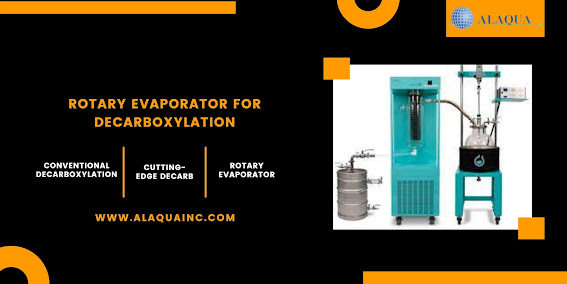
Choosing the Right Rotary Evaporator for Decarboxylation

 Cannabis and hemp laws are slowly loosening around the world after decades of prohibition. In just a few years, wholesale legislative reforms in Canada and the United States have converted an illegal market into a multibillion-dollar legal economy. Cannabinoid-based products, particularly cannabidiol (CBD) oils, have become high-value commodities. Alaqua is processing equipment including evaporators supplier worldwide based in the US.

The cannabis and hemp industries are evolving at a breakneck pace, with producers and retailers alike competing for a competitive edge in an already crowded market. Raw vs. decarbed CBD oil is one of the most important distinctions in the sale of CBD products.

Decarboxylation is a natural part of the cannabis-consuming process. It discusses particular procedures for extracting desirable natural chemicals from plants in laboratory settings. This post will go over the process of decarbing cannabis in greater detail, as well as provide some advice on how to choose the best decarboxylation system.


What is Decarboxylation?

The transformation of CBDA (Cannabidiolic Acid) or THCA (tetrahydrocannabinolic acid) into THC (tetrahydrocannabinol) or CBD (cannabidiol) via heating and drying is referred to as decarboxylation in the cannabis extraction process. In scientific terminology, decarboxylation is a chemical reaction that involves the removal of a carboxyl group using heat and/or chemicals.

Instruments for Conventional Decarboxylation

Traditional decarboxylation and solvent recovery systems are complex, modular systems made up of several interconnected instruments. Decarboxylation alone necessitates a large reactor with a chiller, a condenser chiller, and a vacuum pump. As a result, consumers can decarb cannabis for extended lengths of time (8-10 hours).

Other decarbing equipment, such as vacuum ovens, can take much longer (14-24 hours) and have a restricted capacity. These setups are costly, and they generally necessitate regular operator engagement in order to produce the highest value results.

Due to heat loss and inadequate heat transmission, reactor/chiller decarb systems require a long time to decarb since they use thermal fluid to heat the extract to the appropriate decarb temperature (250 °F or 121 °C).

Evaporators with Cutting-Edge Decarb

Evaporation technology for decarboxylation and solvent recovery beats conventional decarb systems on nearly every front, thanks to ground-breaking direct-cooling technology and continuous feeds to maintain vacuum conditions during extraction procedures.

They can decarb equivalent volumes of cannabis oils in just under 2 hours and offer consistently higher returns on investment in practically every regard. This is made feasible by an efficient heating mantle design that quickly reaches optimal decarb temperatures and maintains heat. With an efficient heating mantle, actual volume evaporators, and the world's most efficient intelligent self-cooling technology, continuous decarboxylation of large volumes of sample materials at unprecedented scales may be initiated with a single operation.

Rotary Evaporators For Lab

Lyman C. Craig, a scientist from the United States, could not have predicted the impact of his invention when it was first introduced in 1950. Rotary evaporators are still used in most modern chemistry laboratories more than 60 years later to meet the needs of scientists all around the world.

Rotovaps are used for fast distillation of mixed solvents, efficient drying of samples, faster freeze-drying sample preparation, chemical synthesis under reflux, natural compound extraction, and concentration due to the wide range of condensers available.

Many research and development applications include evaporation as a stage. Organic synthesis and the extraction of inorganic contaminants both need the concentration of solutions by distilling the solvent and removing low and higher-boiling or solid residue. The chemical, pharmaceutical, petrochemical, and food sectors all employ evaporators outside of research labs.

Working Principle Of Rotary Evaporator

A motor unit, a heated fluid bath, a vacuum system, a vapor duct, a condenser with either a coil passing coolant or a 'cold finger,' a condensate-collecting flask, and a mechanical or motorized mechanism are the main components of a rotary evaporator. The evaporation vial or flask containing the user's sample rotates in a rotary evaporator. The axis for sample rotation is the vapor duct, which is a vacuum-tight conduit for the vapor being drawn off the sample.

The evaporator system's pressure is significantly reduced by the vacuum system. A water aspirator with a trap immersed in a cold bath for non-toxic solvents can be as simple as a regulated mechanical vacuum pump with a refrigerated trap, or as sophisticated as a regulated mechanical vacuum pump with a refrigerated trap. The sample is heated in a hot fluid bath (often water). Depending on the evaporation goals and any propensities that the dissolved chemicals might contribute to the mixture, the condenser utilized in rotary evaporators can be simple or complex. The distilling solvent is caught in the condensate-collecting flask, which is placed at the bottom of the condenser. The evaporation flask is swiftly removed from the heating bath thanks to a motorized mechanism.

Precautions

Although evaporation is a simple process, it is not without risk. For example, implosions can occur when using glassware that has faults, and explosions can occur when concentrating unstable contaminants during evaporation. Avoid tangling loose clothing, hair, or necklaces in rotating parts.

Applications of Rotary Evaporator

The rotary evaporator has a wide range of industrial uses, including crude oil processing, cannabinoid separation, molecular cooking, flavor and aroma production, and more. Rotary evaporators can be used in a variety of industries, whether you're in R&D or manufacturing.

Academia: In academia, solvent re-use is extremely significant. For this and many other applications, including solvent recycling, concentration, and distillation, the rotary evaporator is the best option.

Chemical: Concentration, Drying, and Solvent Recycling are just a few of the applications that an industrial Rotavapor may accomplish in the chemical industry.

Pharmaceutical: The pharmaceutical business requires an evaporation solution that may be used in a variety of situations. For gentle evaporation, the rotary evaporator is the optimum choice: concentration, drying, re-crystallization, and synthesis.

Alaqua supplies processing equipment such as crystallizer, solvent recovery, distillation, heat exchanger, spray dryer, and evaporators made in USA. They also offer installation and commissioning, retrofitting, troubleshooting, personnel training, and various other services for the processing equipment. Contact them today for more queries related to their processing equipment and services!


Wednesday, July 10, 2019

Evaporators vertical long tube is requisite for product recirculation urgency


Evaporators vertical long tube is a utilitarian industrial apparatus that is fruitioned to concentrate thin and foamy liquors rapidly. We are a monad of leading factory appliances designer and manufacturer, fulfilling the technical exigencies of the production house by the installation of machines like crystallizer, heat exchanger, spray dryers, evaporators and so on. This assembly is largely caught in action for the versatile behaviour and least cost per unit of capacity. Dimension of the tubes in this evaporator is 1 to 2 inch in diameter and 12 to 30 feet in length. Operations in the Evaporators vertical long tube chiseled by alaquainc.com may be performed once or recirculation may occur. In the case of once demo, tubes are 16 to 30 feet long, average residence time is a few seconds and there is no liquid level in the vapor body. Apart from the once pattern, in recirculation - tubes are 12 to 20 feet long, a deflector plate remains present in the vapor body and either a level is necessary to maintain. In such processes, recirculated systems are functionated in batch pattern or continuous one.

However, vapor moves agile than the liquid in upward direction through the core of the tube and therefore another name given to evaporators vertical long tube is rising or climbing film evaporator. Hence, the liquid creeps up the tube in a thin film. This movement can only happen in the upper section of the tube. When this procedure abates, the liquid film is quite restless and high heat transfer rate is observed. Evaporators vertical long tube can be invoked for heat sensitive materials as average residence times are minimum.    

Mechanism of a vertical evaporator:

Feed materials penetrated into the evaporators vertical long tube from bottom of the heating tubes. Steam initiates to create as it gets heated. Then, elevated force of this steam generated when boiling resided, causes the liquid and vapors to ambulate upward. In the former second, the production of vapor increases and the product is molded into thin films on the body of the tubes making the liquid rise up. And, this above flow benefits in producing a high rate of turbulence in the liquid. Thus, it is counted as profitable step when viscous products evaporation takes place.        

Boiling and high vapor velocities in association with vaporization of the liquid feed are the factors on which circulation of fluid across the heat transfer surface depends. Liquid’s temperature inside the tubes are neither uniform nor easy to speculate. Evaporators vertical long tube is not much sensitive to changes while operating at high temperature differences. 

Advantages of mobilizing evaporators vertical long tube:

     Low cost of functioning
     Large units of production 
     Less holdup duration
     Small area coverage
     Good heat transfer in a variety of applications

Disadvantages of resorting evaporators vertical long tube:

     Enormous amount of headroom is needed
     Frequent recirculation is essential
     Not suitable for salting or other severely scaling fluid

Applications of evaporators vertical long tube:

It is appropriate for ascribing when have to be dealt with handling of clear fluids, foaming & corrosive flow able substance as well as where there is existence of large evaporation loads.